Large Loss and Catastrophic Response in Freeport
24/7 large loss and catastrophic response in Freeport and surrounding areas. Insurance billing accepted. Call (337) 344-1248.
When a loss stops being a single-room problem and becomes a building-wide one, the usual restoration playbook breaks down fast. A burst main that floods three floors of a commercial building, a fire that guts a wing of an apartment complex, or a storm that tears into a warehouse roof and soaks the inventory below all require a different scale of response: more equipment, more technicians, and a single team that can coordinate drying, demolition, and documentation across a property that may still be partially occupied or operating.
What large loss and catastrophic response actually involves
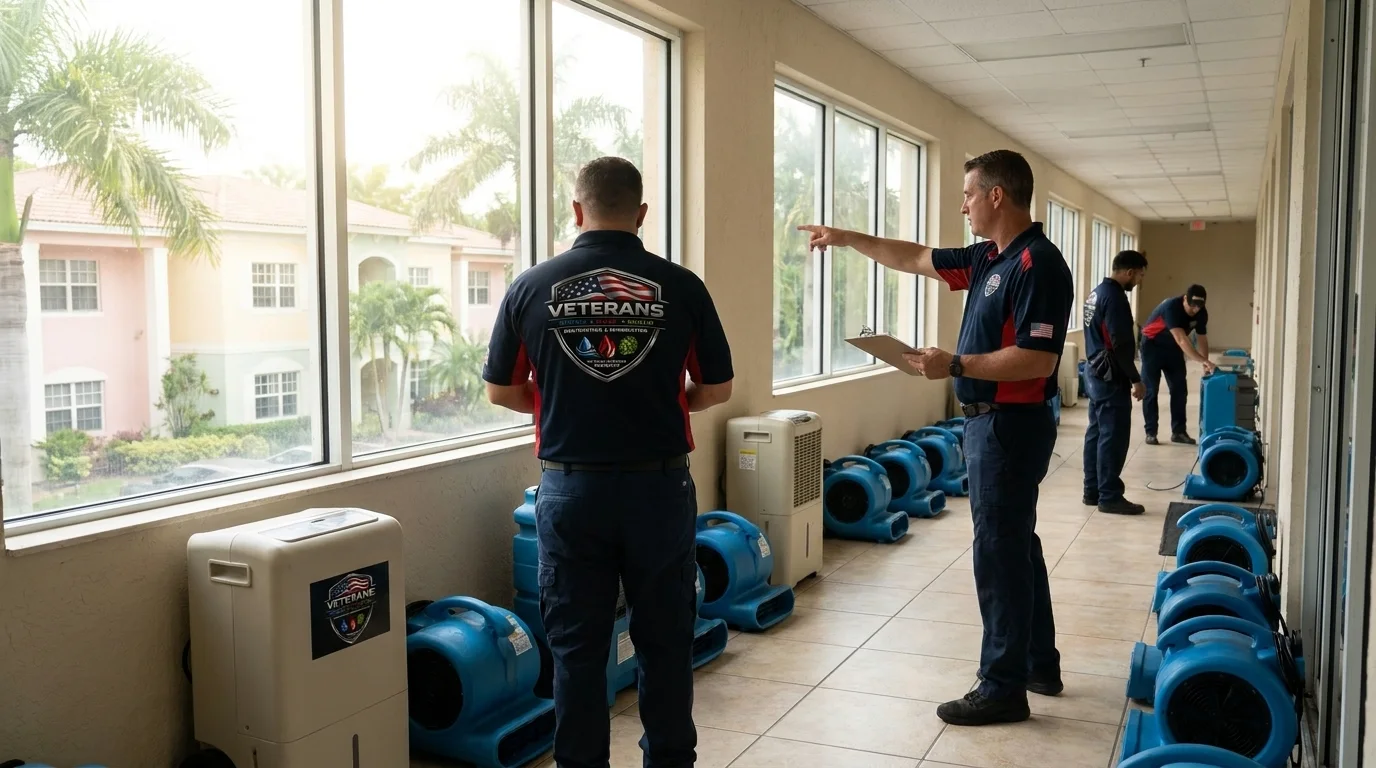
Large loss work covers commercial and multi-family properties, and residential losses severe enough to involve multiple structures, floors, or trades at once. Think hotels, apartment complexes, medical and office buildings, warehouses, and large single-family homes with losses that touch the roof, multiple floor levels, and mechanical systems simultaneously. The equipment footprint is bigger: truck-mount extraction units, banks of low-grain refrigerant dehumidifiers, HEPA air scrubbers staged by zone, and generators where power has been cut to protect electrical systems. Timelines run longer than a typical residential job, often weeks rather than days, because the drying, demolition, and reconstruction phases are happening across a much larger footprint and usually need to be sequenced around tenants, business operations, or ongoing engineering assessments.
Our process
- Rapid site assessment and triage. Before equipment is loaded, the structure gets walked floor by floor to identify the categories of water or fire damage present, which areas are salvageable, and which need to be isolated immediately for safety.
- Mobilization of resources. Large loss jobs need more than one van and one crew. Equipment and technicians get staged according to the size of the affected area, not a flat per-job template.
- Phased mitigation by zone. Rather than treating the whole property as one job, the structure is broken into zones so that drying, demolition, and odor control can move independently without one delayed area holding up the rest.
- Coordination with adjusters, engineers, and property management. Multi-million dollar claims usually involve a larger claims team on the insurance side, sometimes a structural engineer, and often a property manager who needs regular updates on occupancy timelines.
- Documentation built for a large claim. Photos, moisture logs, and daily reports are organized by zone and date so the claim file holds up to scrutiny from a large loss adjuster reviewing a six- or seven-figure estimate.
What separates a good large loss response from a bad one
The most common failure on catastrophic jobs is under-resourcing: a contractor shows up with a residential-sized crew and equipment list for a commercial-sized loss, and drying times stretch out while secondary damage, especially mold, gets a foothold in wall cavities and ceiling systems that never fully dried. The second common failure is documentation that doesn’t scale. A large loss adjuster is reviewing a claim with real financial exposure, and loose or inconsistent moisture logs, missing photos of pre-demolition conditions, or no clear zone-by-zone record slows the claim down and invites disputes. A good response also means a single point of contact who can speak for the whole job, not three separate crews giving the property manager three different timelines. And because large losses often sit open for weeks, ongoing moisture monitoring matters more, not less: a zone that reads dry on day three can still be wet at the subfloor or behind masonry on day fifteen if it wasn’t tracked properly.
What does large loss and catastrophic response cost?
Large loss costs vary enormously based on square footage, number of structures or units affected, and how much of the work involves demolition and reconstruction versus mitigation alone. Every property and every claim is different, which is why Veterans Remediation & Restoration provides a written scope of work before mitigation begins rather than a flat estimate. Commercial property insurance typically covers large loss mitigation and reconstruction when the cause of loss is covered under the policy, but business interruption, code upgrades, and contents coverage vary significantly by policy and are worth reviewing with your adjuster early.
| Scenario | Typical range |
|---|---|
| Single-floor commercial water loss, clean water | $15,000 - $45,000 |
| Multi-floor flood in office or commercial building | $75,000 - $300,000 |
| Apartment complex fire, partial structure | $150,000 - $750,000 |
| Warehouse or industrial facility water loss with inventory | $100,000 - $500,000 |
| Multi-building storm damage across a commercial property | $250,000 - $1,500,000+ |
Seasonal & regional considerations
Freeport and the surrounding Gulf Coast sit in an active hurricane corridor, and large loss events here are often tied to named storms rather than isolated accidents: a hotel roof failure during a tropical system, or an apartment complex that takes on water across multiple units from wind-driven rain. The region’s humidity also raises the stakes on timeline. In a large commercial loss where drying stretches across several weeks, Gulf Coast humidity levels push structural materials back toward saturation faster than in drier climates, which is part of why zone-by-zone moisture monitoring matters more here than it does in a single-room residential job.
Service area
Veterans Remediation & Restoration responds to large loss and catastrophic events throughout Freeport and the surrounding Walton County area, including Santa Rosa Beach, DeFuniak Springs, Niceville, Crestview, and Fort Walton Beach.
If your property is facing a loss too large for a standard crew to handle, start with a scoped large loss assessment so you know what’s involved before demolition begins.
Frequently Asked Questions
Does homeowners or commercial property insurance cover large loss and catastrophic damage?
How is a large loss response different from a standard residential water or fire job?
Who coordinates with the insurance adjuster on a catastrophic claim?
Can a business or apartment complex stay partially occupied during a large loss response?
What happens if secondary damage like mold shows up during a large loss drying process?
Looking for the best large loss and catastrophic response company in Freeport?
Veterans Remediation & Restoration provides large loss and catastrophic response in Freeport, FL and the surrounding area, and has served local property owners since 2020. We answer calls 24/7 — call (337) 344-1248 for immediate help.
Need Large Loss and Catastrophic Response now?
We respond 24/7 across Freeport and surrounding FL cities.
Related Coverage
- Our Restoration Services
- Contact Veterans Remediation & Restoration
- Restoration Services in Crestview
- Restoration Services in DeFuniak Springs
- Restoration Services in Destin
- Restoration Services in Ebro
- Restoration Services in Eglin AFB
- Restoration Services in Fort Walton Beach
- Restoration Services in Harold
- Restoration Services in Hurlburt Field
- Restoration Services in Laurel Hill
- Restoration Services in Miramar Beach
- Restoration Services in Navarre
- Restoration Services in Niceville